If the Saturn Cycle shows the major phases of life, the Mars Cycle shows what happens within them, month by month. It is the plot you consult to decide when to schedule a conversation, launch a project or ease off the accelerator.
Mars, the planet

Mars is the fourth planet from the Sun and the second smallest in the Solar System. The Martian day is similar to ours: 24 hours and 37 minutes. The year is longer: Mars takes 687 Earth days to go around the Sun.
The iron oxide on its surface gives it the color that earned it the nickname Red Planet. The Romans named it after their god of war.
Mars in astrology
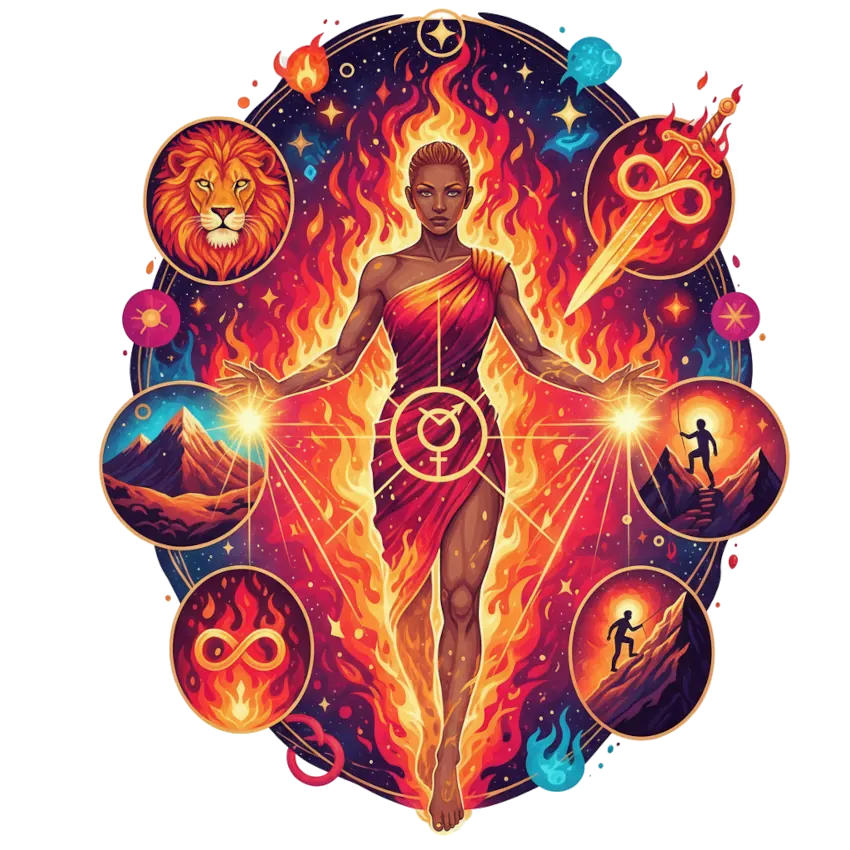
In astrology, Mars goes beyond war. It is the impulse that sets things in motion: initiative, courage in the face of challenges, determination and the energy needed to reach goals and assert one's individuality.
That is why the Mars cycle is read as the cycle of action. It does not show the great structures, but the moments to advance and the moments to pull back.
The short-term cycle
The passage of Mars through the astrological degrees of birth generates the Short-Term Cycle, also called the Annual Cycle. Like Saturn's, it alternates positive and negative periods and brings its own ephemerides.
| Interval | Duration |
|---|---|
| Full cycle | 1 year and 9 months to 2 years and 3 months |
| Subcycle | 10 to 16 months |
| Positive period | 5 to 8 months |
| Negative period | 5 to 8 months |
| Between one phase and the next | 2 to 6 months |
What changes when Mars goes retrograde
The length of the cycle varies because of retrogradation. Seen from the Earth, the planets seem, from time to time, to move backward in the sky. Mars stays retrograde for 70 to 80 days, and the interval between the end of one retrogradation and the start of the next is about 2 years, 1 month and 19 days.
This affects the phases. Under normal conditions, each phase of the Mars Cycle acts for about two to six weeks. When it coincides with a retrogradation, it can extend to about six months.
Positive and negative periods
The reading is the same as in the long term. In positive periods energy expands, and plans meet more ease. In negative periods energy contracts, and initiatives cost more. Boldness when the curve is high, caution when it is low.
The phases of the Mars Cycle, in short
The meaning of the phases is very similar to that of the phases of the Saturn Cycle, on a smaller scale.
| Milestone | In short |
|---|---|
| Phase 1 | A new descent. Obstacles increase and the rhythm of routines changes. |
| Between Phases 1 ↔ 2 | Tension and a feeling of stagnation. Better to replan than to decide on impulse. |
| Phase 2 | Lowest point. Intense effort and overload, but temporary. |
| Between Phases 2 ↔ 3 | Reaction. Determination with discernment prepares the next achievements. |
| Phase 3 | Turning point. Concrete advances begin; a good moment to start projects. |
| Between Phases 3 ↔ 4 | Momentum. Actions become more effective and results come more easily. |
| Phase 4 | Highest point. Balance, clarity and confidence. |
| Between Phases 4 ↔ 1 | Harvest. The fruits of what was done in the previous months appear. |
Mars follows Saturn
The polarity of Mars depends on Saturn's. Whenever Saturn reaches Phase 1 or Phase 3 of the long-term cycle, Mars changes polarity too.
On the Mars plot, this transition appears as two ephemerides without letters, which indicate the Saturn Change and the exact date on which it occurs. From then on, the polarity of the Mars ephemerides is reversed. The reading stays the same: identify the phases and the ephemerides of the cycle.
The short-term ephemerides
Besides the phases, the Mars plot brings two kinds of date: the Venus ephemerides, which are favorable windows, and the caution periods, which call for more care. Together, they show which months of the cycle tend to be lighter and which tend to be more demanding.
Frequently asked questions
How long does the Mars Cycle last?
From 1 year and 9 months to 2 years and 3 months. Each period, positive or negative, lasts 5 to 8 months.
What happens when Mars goes retrograde?
Seen from the Earth, Mars seems to move backward in the sky for 70 to 80 days. In that stretch the cycle moves more slowly, and a phase that would last a few weeks can extend to about six months.
What is the difference between the Mars Cycle and the Saturn Cycle?
The scale. The Saturn Cycle shows the major phases of life, in periods of about seven years. The Mars Cycle shows the rhythm of the months, in periods of five to eight months.
Why does the Mars curve change when Saturn changes phase?
Because the polarity of Mars depends on Saturn's. When Saturn reaches Phase 1 or Phase 3 of the long-term cycle, the polarity of Mars reverses, and the plot records the date.
How far ahead can I plan with the Mars Cycle?
The most common use is to plot the next 24 months, which covers roughly one whole cycle.