In cycle astrology, Saturn is the celestial body that sets the slowest and most structural rhythm of life. It is from Saturn that AstroVeliti calculates the so-called Basic Life Cycle, also known as the long-term cycle. This page explains what this cycle is, how it is formed, how long it lasts and what the plot shows.
Saturn, the planet
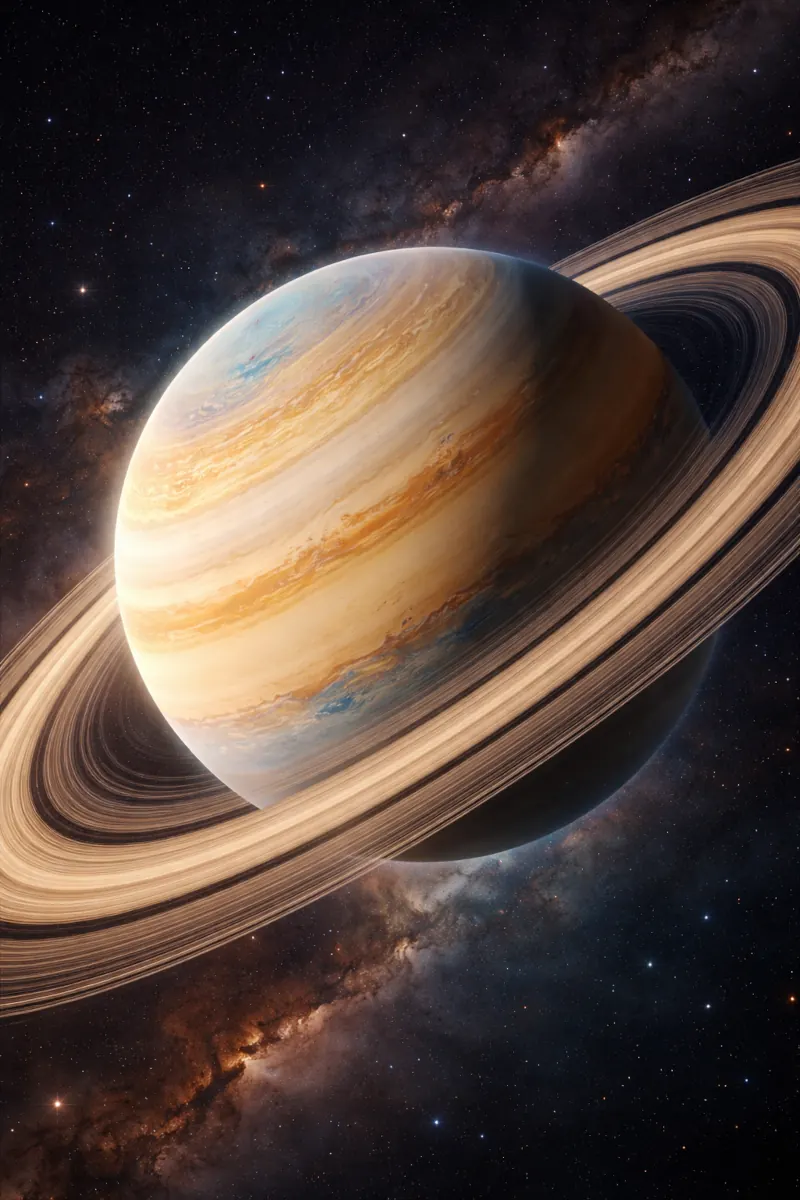
Saturn is the sixth planet from the Sun and the second largest in the Solar System. It spins quickly on its axis, in a little over ten and a half hours, but moves slowly around the Sun: one full turn takes about 29 and a half Earth years.
That slowness is what makes Saturn a good hand for measuring long times. While the Earth completes almost thirty turns, Saturn completes one. Following its position in the sky means, in practice, following a clock of decades.
Saturn and Cronus, the god of time
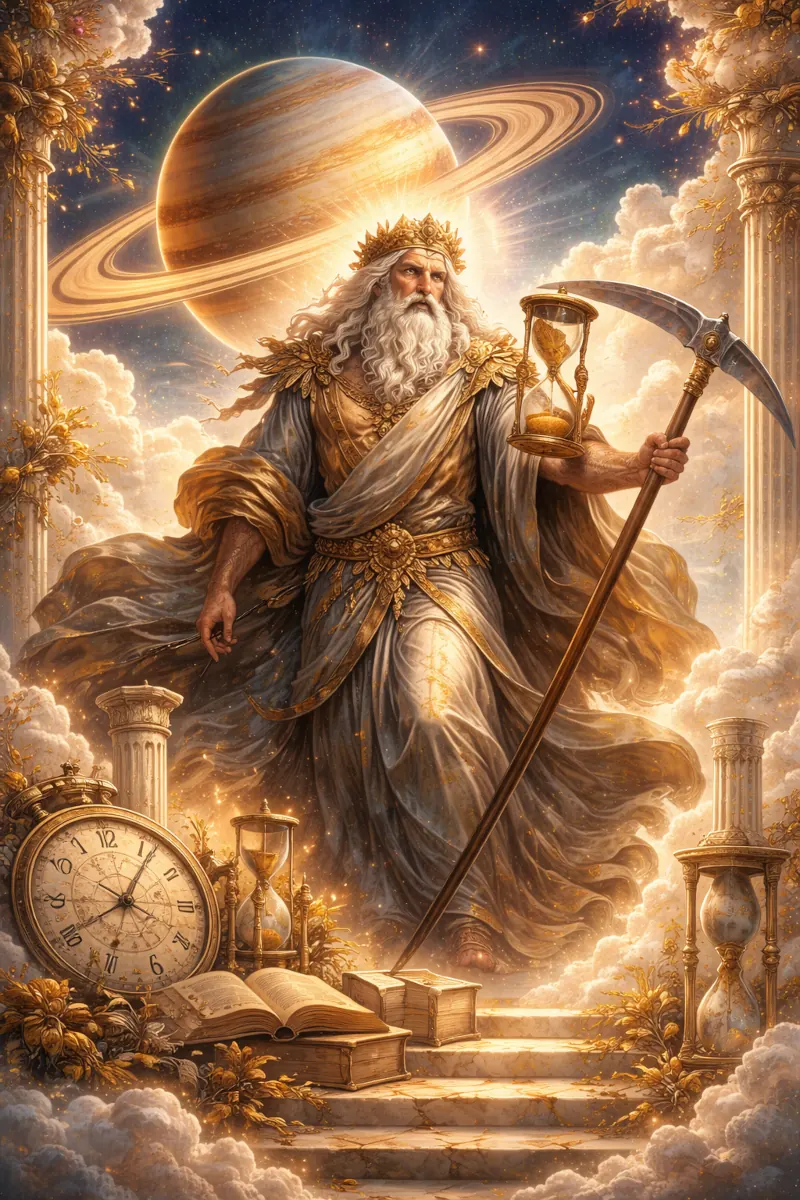
Saturn is the Roman name of the Greek god Cronus. In Rome, Saturn was the god of creation and destruction, of abundance, of cultivation and of the cycles of renewal. In Ancient Greece, Cronus was the youngest of the Titans, son of Uranus (the sky) and Gaia (the earth), and also the god of time.
The association between Saturn, time, sowing and harvest runs through the history of astrology. It helps explain why the Saturn cycle is read as a cycle of sowing and result.
How the Saturn Cycle is formed
At the moment of birth, each person has a set of astrological degrees of birth, defined by the position of the Sun on that day. Throughout life, Saturn passes through these degrees. The drawing of that passage over time is the Saturn Cycle.
AstroVeliti represents the cycle as a wave-shaped curve, the sine curve. When the curve is above the middle line, the period is positive: personal energy is expanding. When it is below, the period is negative: energy is contracting.
Positive and negative carry no moral meaning here. They do not mean good and bad, but more or less energy available to act. The four phases of the cycle detail what each stretch of the curve tends to call for.
How long the Saturn Cycle lasts
Each Saturn Cycle lasts between 28 and 30 years. It is divided into two subcycles, and each subcycle has a positive period and a negative period.
| Interval | Duration |
|---|---|
| Full cycle | 28 to 30 years |
| Subcycle | 14 to 16 years |
| Positive period | 7 to 9 years |
| Negative period | 7 to 9 years |
| Between one phase and the next | 2 to 3 years |
The duration is not exact for two reasons. The first is retrogradation: seen from the Earth, the planets seem to move backward in the sky for a few months each year, and the astrological degrees move back with them. The second is the calendar itself: an Earth year has 365 days, 5 hours, 48 minutes and a few seconds, which is why it needs adjusting every four years.
What the Saturn plot shows
The long-term plot is the Saturn Cycle curve drawn for one person, with the dates of each turning point. It shows:
- the positive and negative periods, with the month and year in which each one begins and ends;
- the phases 1 to 4, which mark the start of the descent, the lowest point, the start of the rise and the highest point;
- the ephemerides of Jupiter, Neptune, Uranus and Pluto, which reinforce or stir up the current phase;
- the windows of opportunity, marked with the letter X.
To read the dates and symbols, see how to read a plot.
Saturn Cycle and Saturn return
Anyone researching Saturn in astrology soon comes across the expression “Saturn return”: the moment, at around age 29, when the planet comes back to the point of the sky it occupied at birth. It is a well-known milestone, associated with entering adult life.
The AstroVeliti Saturn Cycle is a broader reading. Instead of looking at a single moment, it follows a whole lifetime and divides it into stretches of about seven years, each with its dates. The return is a point; the cycle is the full timeline.
How to use the cycle for planning
The most common use has two steps. First, confirm the past: plot an interval that includes years already lived and compare the turning points of the curve with what actually happened. Then, plan: look at the coming years and decide what makes sense to start, consolidate or postpone.
That is why it pays to choose wide intervals, covering past and future in the same plot. In positive periods, new projects and bold decisions tend to meet less resistance. In negative periods, it pays more to preserve what has worked and to prepare the projects that will mature in the next rise.
The cycle indicates tendencies, not events. It does not replace your own judgment or professional advice, and the choices remain yours.
Frequently asked questions
How long does the Saturn Cycle last?
From 28 to 30 years. Each cycle has two subcycles of 14 to 16 years, and each subcycle has a positive period and a negative period of 7 to 9 years.
Is the Saturn Cycle the same as the Saturn return?
Not exactly. The Saturn return is the moment, at around age 29, when the planet comes back to the position it held at birth. The AstroVeliti Saturn Cycle follows Saturn's passage through the astrological degrees of birth over a whole lifetime and divides that journey into phases.
Why do people talk about seven-year periods?
Because one turn of Saturn takes about 29 and a half years and the curve of the cycle has four stretches: two rising and two falling. Each stretch lasts, on average, a little over seven years.
Does the Saturn Cycle apply only to people?
No. The plot can also be made for organizations, institutions, cities and countries, from their founding date.
Does being in a negative period mean everything will go wrong?
No. Negative, here, means contracting energy: a period that calls for more caution and planning. The choices remain each person's own.